
Disposable Vape
What Is MTL and DTL Vaping, and What Is the Difference Between Them?
Aug
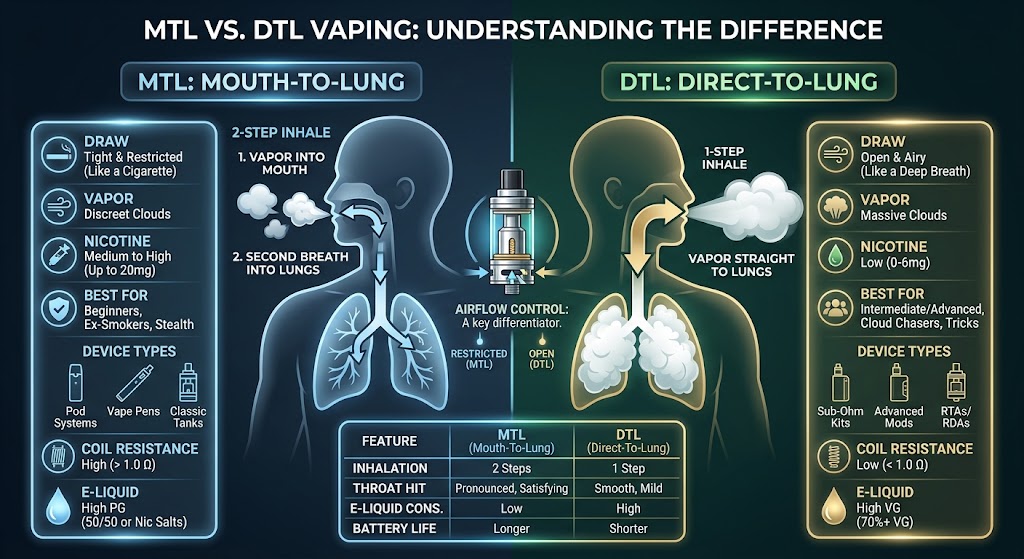
If you are new to vaping, you may frequently come across the terms MTL and DTL. These describe two different inhaling styles: Mouth-to-Lung and Direct-to-Lung. Each method offers a different airflow, throat hit, vapour output and overall experience.
Understanding the difference between MTL and DTL vaping can help you choose the right vape device, coil, e-liquid and nicotine strength.
What Is MTL Vaping?
MTL stands for Mouth-to-Lung. With this method, you first draw the vapour into your mouth and then inhale it into your lungs.
The process is simple:
- Draw the vapour slowly into your mouth.
- Hold it briefly.
- Inhale it into your lungs.
- Exhale.
This inhaling style feels similar to smoking a traditional cigarette, which is why many beginners and former smokers prefer it.
Main Features of MTL Vaping
- Tight and controlled airflow
- Smaller vapour clouds
- Noticeable throat hit
- Lower power consumption
- Longer battery life
- Slower e-liquid consumption
- Commonly used with higher-resistance coils
- Suitable for nicotine salts and moderate nicotine strengths
MTL devices normally operate at a lower wattage and often use coils with a resistance of around 0.8Ω or higher, although this can vary between devices.
What Is DTL Vaping?
DTL stands for Direct-to-Lung. With this technique, you inhale the vapour directly into your lungs in one continuous breath, similar to taking a deep breath.
The process is:
- Press the fire button or inhale from a draw-activated device.
- Take a long, steady breath directly into your lungs.
- Exhale the vapour.
DTL vaping uses more airflow and produces significantly larger vapour clouds than MTL vaping.
Main Features of DTL Vaping
- Open and airy draw
- Larger vapour production
- Warmer vapour
- Stronger flavour intensity
- Higher power consumption
- Faster e-liquid consumption
- Usually used with sub-ohm coils
- Better suited to lower nicotine strengths
DTL devices commonly use coils below 1.0Ω and operate at higher wattages. Because they produce more vapour with each inhale, lower nicotine levels—often between 0 mg and 6 mg/mL—are generally preferred.
MTL vs DTL: What Is the Difference?
| Feature | MTL Vaping | DTL Vaping |
|---|---|---|
| Full name | Mouth-to-Lung | Direct-to-Lung |
| Inhaling method | Vapour enters the mouth before the lungs | Vapour goes directly into the lungs |
| Draw style | Tight and restricted | Open and airy |
| Vapour production | Small and discreet | Large and dense |
| Throat hit | More noticeable | Usually smoother at low nicotine levels |
| Coil resistance | Usually higher resistance | Usually sub-ohm |
| Power requirement | Lower wattage | Higher wattage |
| E-liquid consumption | Lower | Higher |
| Battery usage | Lower | Higher |
| Typical nicotine level | Moderate or higher | Lower |
| Best suited to | Beginners and former smokers | Experienced users and cloud enthusiasts |
These are general guidelines. The exact experience will depend on the device, coil, airflow setting, e-liquid and power level.
Which E-Liquid Is Best for MTL Vaping?
MTL devices usually work best with thinner e-liquids, particularly a balanced 50VG/50PG formula.
PG, or propylene glycol, carries flavour effectively and produces a more noticeable throat hit. Because MTL coils have smaller liquid channels, thinner e-liquid can also reach the coil more efficiently.
Suitable options may include:
- 50VG/50PG e-liquid
- Nicotine salt e-liquid
- Moderate-strength freebase nicotine
- E-liquids recommended by the device manufacturer
Very thick, high-VG e-liquid may not work properly in some compact MTL devices.
Which E-Liquid Is Best for DTL Vaping?
DTL devices usually perform better with thicker, high-VG e-liquids. A common option is 70VG/30PG.
VG, or vegetable glycerin, helps produce smoother vapour and larger clouds. Because DTL devices use larger coils and wider liquid channels, they can generally handle thicker e-liquid more effectively.
Suitable options may include:
- 70VG/30PG e-liquid
- Low-strength freebase nicotine
- Nicotine-free e-liquid
- E-liquid designed for sub-ohm devices
Avoid using high nicotine strengths in a powerful DTL device unless the manufacturer specifically states that it is suitable. The large amount of vapour produced with each inhale can make the nicotine delivery feel excessively strong.
What Is RDL Vaping?
RDL means Restricted Direct-to-Lung. It sits between MTL and DTL vaping.
With RDL vaping, the vapour is inhaled directly into the lungs, but the airflow is more restricted than a traditional DTL draw. It produces more vapour than MTL while remaining tighter and more controlled than DTL.
RDL may be suitable for users who want:
- More vapour than MTL
- Strong flavour
- A moderately airy draw
- Lower power consumption than full DTL vaping
- A balance between throat hit and smoothness
Many modern pod systems and adjustable-airflow disposable vapes support an RDL-style draw.
Is MTL or DTL Better for Beginners?
MTL is generally easier for beginners because its inhaling technique feels familiar to people who previously smoked cigarettes. MTL devices are also usually smaller, easier to operate and more economical with e-liquid and battery power.
DTL vaping may require more knowledge about wattage, coil resistance, airflow and compatible e-liquid. It can still be suitable for beginners who prefer an open draw, but choosing the correct nicotine strength is important.
How to Choose Between MTL and DTL
Choose MTL vaping if you prefer:
- A cigarette-like draw
- A noticeable throat hit
- Smaller and more discreet vapour clouds
- A compact, low-power device
- Lower e-liquid consumption
- Nicotine salt or moderate-strength e-liquid
Choose DTL vaping if you prefer:
- An open and airy inhale
- Larger vapour clouds
- Warmer and fuller vapour
- Lower nicotine strengths
- Adjustable wattage and airflow
- High-VG e-liquid
Neither style is automatically better. The right choice depends on your preferred draw, nicotine needs, vapour production and device type.
Are Disposable Vapes MTL or DTL?
Many disposable vapes are designed for MTL or restricted DTL vaping, but this is not true for every device. Compact disposables commonly offer a tighter MTL draw, while larger devices with adjustable airflow and powerful mesh coils may support RDL or DTL vaping.
Check the product specifications for information about:
- Airflow control
- Coil resistance
- MTL or DTL modes
- Nicotine strength
- Recommended inhaling style
Do not assume that a high-puff disposable vape is automatically a DTL device. Puff capacity describes its estimated usage, not its inhaling style.
Frequently Asked Questions
Can I use an MTL e-liquid in a DTL device?
It may be technically possible, but an e-liquid with high nicotine or high PG can feel very harsh in a powerful DTL device. Always follow the device and coil recommendations.
Can I use high-VG e-liquid in an MTL vape?
Some MTL devices can handle high-VG e-liquids, but many small coils require a thinner formula. Using e-liquid that is too thick may cause poor wicking, weak flavour or dry hits.
Does MTL vaping use less e-liquid?
Yes. MTL devices generally produce less vapour per puff, so they usually consume less e-liquid than DTL devices.
Does DTL vaping produce more flavour?
DTL vaping can produce stronger and fuller flavour because more e-liquid is vaporised. However, a good MTL device can also provide excellent flavour with less vapour.
Can one vape device support both MTL and DTL?
Some devices offer adjustable airflow, multiple coil options or separate vaping modes that support both styles. However, not every device is designed for both, so check the specifications before changing your inhaling method.
Is MTL vaping safer than DTL vaping?
Neither vaping style is risk-free. The level of exposure depends on several factors, including the device, e-liquid, nicotine strength, puff frequency and amount of vapour inhaled. Vaping products are intended only for adults, and nicotine is addictive.
The main difference between MTL and DTL vaping is how the vapour is inhaled. MTL vaping draws vapour into the mouth before inhalation, providing a tighter draw, smaller clouds and a cigarette-like experience. DTL vaping sends vapour directly into the lungs, creating a more open draw and much larger clouds.
MTL is often suitable for beginners, former smokers and users who prefer a discreet experience. DTL is generally preferred by those who enjoy open airflow, fuller vapour and larger clouds. Whichever style you choose, use a compatible device, coil, e-liquid and nicotine strength for the best experience.
